Physics of Soft Matter Lab
Research Assistant
September 2023 – January 2025 · Harvey Mudd College
Studied the physics of latch-mediated spring-actuated systems through experiments and simulation, and automated the lab's recoil-motion analysis.
 Open full size ↗
Highlights
- Automated recoil-motion analysis in MATLAB, tracking elastic-material position with the Computer Vision Toolbox and smoothing the data to characterize energy efficiency.
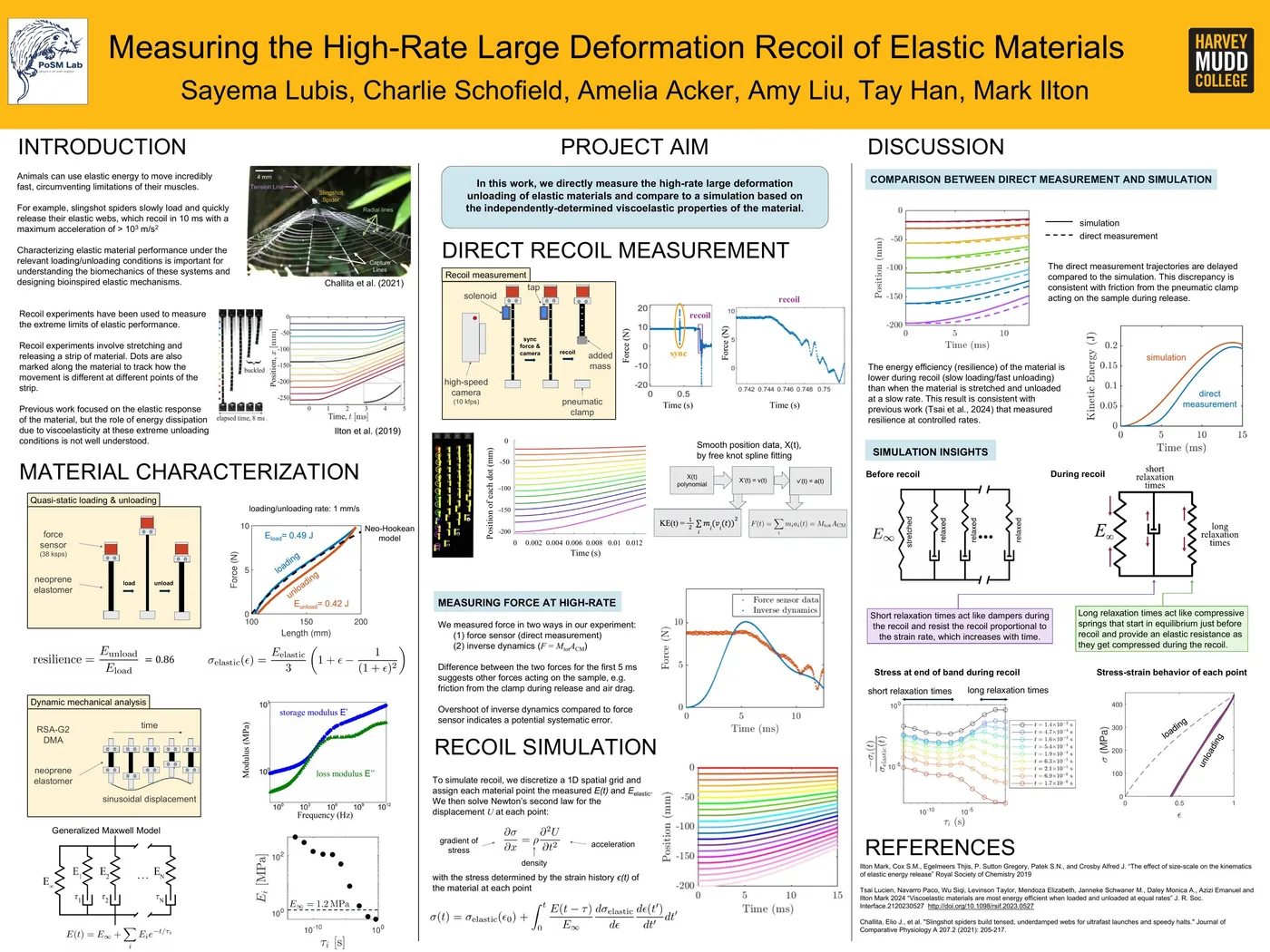
- Co-authored the poster "Measuring the High-Rate Large Deformation Recoil of Elastic Materials," presented at the SoCal Soft Matter Symposium and the APS Physics Global Summit.
The research
Animals like slingshot spiders store elastic energy slowly and release it almost instantly: their webs recoil in about 10 ms with accelerations above 10³ m/s². Our lab, led by Prof. Mark Ilton, studies the physics behind these latch-mediated spring-actuated systems. In this project we measured how an elastic strip recoils at high rates and large deformations, and compared it to a simulation built from the material’s independently measured viscoelastic properties. You can read more about the lab at posmlab.org.
My contribution
In the recoil experiment, a neoprene strip marked with dots is stretched, held by a pneumatic clamp, and released while a high-speed camera films it at 10,000 frames per second. I automated the analysis in MATLAB. The Computer Vision Toolbox tracks every dot frame by frame, and I smooth the position data with free-knot spline fitting so it can be differentiated cleanly into velocity and acceleration. From those I compute kinetic energy and the force on the strip by inverse dynamics (F = M·aCM), which we checked against a force sensor sampling at 38 kHz.
What we found
- The material is less energy-efficient during a fast recoil than when it is loaded and unloaded slowly (0.86 resilience at 1 mm/s), which matches earlier controlled-rate measurements.
- The measured trajectories lag the simulation slightly, which is consistent with friction from the clamp during release.
- In the viscoelastic model, short relaxation times act like dampers during recoil, while long relaxation times act like compressed springs.
Poster
Measuring the High-Rate Large Deformation Recoil of Elastic Materials. S. Lubis, C. Schofield, A. Acker, A. Liu, T. Han, M. Ilton. Presented at the SoCal Soft Matter Symposium and the APS Physics Global Summit. Download the poster (PDF)